
We run our website the way we wished the whole internet worked: we provide high quality original content with no ads. We are funded solely by your direct support. Please consider supporting this project.

Reflecting on Open2013
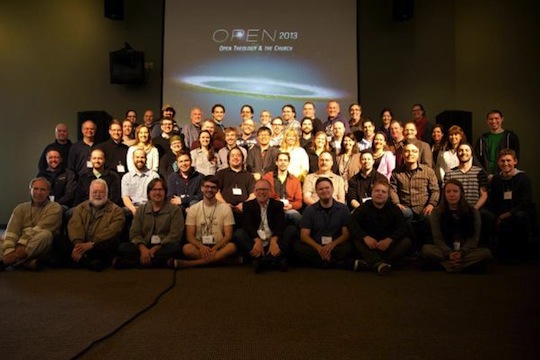 T. C. Moore has posted some of his reflections from the Open Theism conference. T. C. was one of several people who pulled this conference together and he did a great job. He’s also incredibly smart and very active in the open view community. Also, he’s a young church planter in Boston and I’m sure he’s grieving with the rest of that city (and the world) after the bombings yesterday. Our hearts are broken with him. Lord Jesus bring your peace and reveal your heart in the aftermath of this tragedy.
From T. C.’s blog:
The conference was held at Woodland Hills Church and senior pastor Greg Boyd was one of the conference’s keynote speakers.John Sanders and Thomas Jay Oord also delivered keynote talks. All three keynote speakers did a fantastic job, and each one provided substantive Q&A sessions following their talks. Dr. Oord even integrated Q&A into his presentation making it extraordinarily interactive. But one undeniable highlight of the conference was Jessica Kelley‘s sharing of Henry’s Story. Her testimony of how the Open View and the Warfare Worldview has helped her process her pain and preserved her faith in God was definitely the emotional pinnacle of the conference. Several of us on the planning team noted her poise during Q&A and her powerful gift of clear communication.
Category: General
Tags: Boston Bombings, Open Theism, T.C. Moore
Related Reading

What is the significance of Exodus 33:1–3, 14?
“The Lord said to Moses, ‘Go, leave this place, you and the people whom you have brought up out of the land of Egypt, and go to the land of which I swore to Abraham, Isaac, and Jacob…I will send an angel before you, and I will drive out the Canaanites…Go up to the land…

How Much of the Future is Settled? How Much is Open? (podcast)
Greg considers the mathematical nature of determinacy. Episode 566 http://traffic.libsyn.com/askgregboyd/Episode_0566.mp3
How do you respond to Jeremiah 25:8–12?
The Lord says to the nations: “Because you have not obeyed my words” (vs. 8), “this whole land shall become a ruin and a waste, and these nations shall serve the king of Babylon seventy years. Then after seventy years are completed, I will punish the king of Babylon and that nation, the land of…
How do you respond to Matthew 26:36?
At the last supper Jesus said to Peter, “Truly I tell you, this very night, before the cock crows, you will deny me three times.” This is probably the most frequently quoted verse by defenders of the classical understanding of God’s foreknowledge against the open view. How, they ask, could Jesus have been certain Peter…
Theo Graff Podcast: Featuring Jessica Kelley
We have a special treat for you today. T. C. Moore is a great friend of ReKnew and he’s recently started a “Jesus-centered, hip hop flavored, geeky, theological, kingdom exploration” called the THEO GRAFF PODCAST. He’s published four podcasts so far and you’ll want to listen to them all when you get a chance, but we wanted…
A Brief Outline and Defense of the Open View
While many Christians have found the open view of the future to be the most helpful and accurate view of God’s foreknowledge of the future based on biblical, philosophical, and experiential evidence, others have criticized the view as unorthodox and even heretical. What follows is a brief description and defense of the open view prepared…