
We run our website the way we wished the whole internet worked: we provide high quality original content with no ads. We are funded solely by your direct support. Please consider supporting this project.
A Dialogue with Derek Flood Part 2: Is ALL of the Bible Inspired?
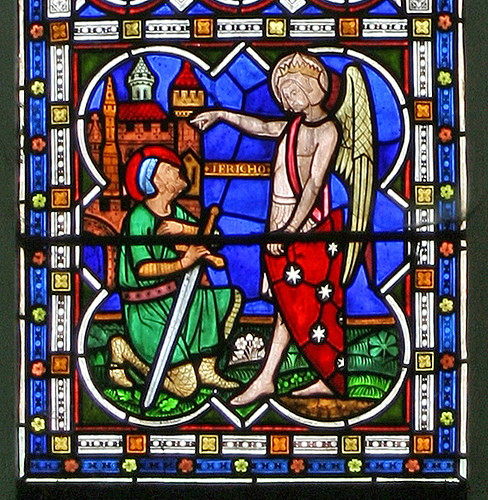
Image by TheRevSteve via Flickr
Yesterday, I offered the first part of my response to Flood’s comments regarding my review of his book. Today I’ll finish up my thoughts.
Scripture and Its Interpretation
Flood confesses that he is confused as to how I can claim that “in the light of Christ, we must reject violent interpretations of Scripture” while “simultaneously” arguing that “Jesus and Paul never felt free to simply reject any portion of Scripture.” “How does that make any sense?,” he wonders, and he answers his own question by stating: “It frankly doesn’t.”
I humbly beg to differ. I think it makes total sense once we distinguish between Scripture, on the one hand, and its interpretation, on the other. As I said above, I concur with Derek that Jesus and Paul rejected violent interpretations of Scripture, and I agree that we should follow their precedent. But I find no evidence that Jesus or Paul ever felt free to reject any portion of Scripture itself. It seems to me that the very fact that the Gospel authors as well as Paul went to such remarkably creative lengths to demonstrate how various OT passages point to Christ reflects the depth of their conviction that all Scripture must somehow bear witness to him. This, I contend, is a conviction we should embrace and a precedent we should follow.
Perhaps one reason Derek doesn’t embrace this conviction is that he argues that understanding violent divine portraits “is not a matter of interpretation, of us somehow reading it wrong. It is simply what the texts actually proclaim and promote.” He is right about this as it concerns the human authorship of these texts. But because of the shared conviction that all Scripture has a divine author as well as human author, neither the authors of the NT nor anyone else in the historic-orthodox theological tradition has felt bound to the surface meaning of biblical texts. And as Origen frequently reiterated, when the surface meaning of a text seems “unworthy of God,” this simply means that the Spirit is calling on us to dig deeper to discover the “hidden treasure” buried in the “depth” of the text.
Along these same lines, I agree with Flood that “[i]f we are to have a redemptive reading” of Scripture’s violent passages, “we must begin by first facing these texts for what they are,” which means taking a “hard look at the sin that is mirrored in these texts.” Yet, if we retain the confidence that all Scripture is “breathed” for the purpose of bearing witness to Christ, and more specifically, to his sufferings on the cross (Lk 24:25-7, 45-6), we can begin to discern that there is more going on in these texts than mirroring people’s sinful views of God. My claim is that we can, and should, begin to connect the dots between the God who “breathed” these sin-mirroring literary portraits and the God who “breathed” his definitive self-revelation by bearing the sin of the world and taking on a semblance that mirrored this sin.
The Meaning of Inspiration
Finally, Flood takes me to task for “putting words in his mouth” by claiming that he denies the divine inspiration of all Scripture. I sincerely apologize for my misunderstanding, and putting words in someone’s mouth that misrepresent their views is the very last thing I would ever want to do, having myself been the victim of that tactic far too many times. I will simply explain how I arrived at this conclusion.
Derek actually says very little about the inspiration of Scripture in Disarming Scripture. There are eights pages in a section entitled, “The Inspiration of the Holy Spirit” (250-8), but after two paragraphs outlining his view (251) Derek quickly moves on to comparing and contrasting his view with others. If I’m not mistaken, neither in those two paragraphs, nor anywhere else in his book does Derek affirm that all Scripture is inspired by God. He rather says that, “the Bible is inspired by God when it leads us to an encounter with the Spirit of God in Christ—when it leads us to love.” While the Bible is “a dead book” apart from the present work of the Spirit, “through the living Spirit of God the text can come alive, pointing us to Christ. The text alone is not inspired apart from the Spirit,” but “it becomes inspired (in-Spirit-ed) as the rema word of God breathes life into Scripture …” (emphasis original).
While I can’t go into it now, I would argue that this dynamic conception of inspiration is not consistent with the views of Jesus or Paul or of any representative in the historic orthodox church up to the 20th century.[1] But the more important point is that, while I can understand how Derek could affirm that “all Scripture can become inspired,” I honestly don’t understand how he could affirm that “all Scripture is inspired.” My bewilderment increases when I consider Derek’s claims that, Jesus and Paul felt free to reject portions of Scripture and that Jesus even attributed some narratives “to the way of the devil, rather than the way of God” (42). Since Derek offered no explanation as to how a narrative could be “breathed by God” and yet be rejected and even attributed to “the way of the devil,” I was led to the conclusion that he did not affirm that “all Scripture is breathed by God.” Nevertheless, while I still don’t understand how Derek can affirm this, he did so in his response to my review and I take him at his word. I thus apologize for attributing this view to him.
I will close with this observation. I believe that one advantage of the cross-centered understanding of biblical inspiration and biblical infallibility that I’ll unpack and defend in The Crucifixion of the Warrior God is that it enables us to offer the explanation that was lacking in Disarming Scripture. That is, the cruciform approach allows us to affirm that the surface meaning of certain passages must be rejected while at the same time affirming their divine inspiration of infallible authority. For the God who “breathed” his full revelation on Calvary by humbly stooping to bear our sin and our curse is the same God who “breathed” all Scripture by sometimes stooping to bear the sin and curse of his people’s fallen and culturally conditioned views of him. And if we remain fully confident that the cross reveals God’s very essence without losing confidence that all Scripture is “breathed” by God for the purpose of bearing witness to the cross, my conviction is that Scripture performs this function infallibly.
[1] Derek refers to Stanley Grenz’s discussion (in Renewing the Center [Baker Academic, 2000], 72-3) of certain 18th century Evangelicals to argue that his view is not unique. Even this is debatable, however. I would argue that, while the Evangelicals in question emphasized how the Spirit uses Scripture to advance the kingdom, this didn’t define their conception of biblical inspiration, as it seems to for Derek.
Category: General
Tags: Bible, Biblical Authority, Book Reviews, Cruciform Theology, Derek Flood, Disarming Scripture, Inspiration, Jesus
Topics: Interpreting Violent Pictures and Troubling Behaviors
Related Reading

Close Encounters of the Third (Kingdom) Kind: A Reflection on the Missio Alliance Conference
What an incredible gathering we had last week! It was invigorating, informative and fun! What stands out most to me was the family-feel of the conference. Like most of you, I have usually felt a bit alien when attending Christian conferences throughout the years. Not this one. You could sense the shared kingdom ethos in…
Reviewing the Reviews: Derek Flood
In this second “Review of the Reviews” of Crucifixion of the Warrior God, I will discuss the three-part review of Derek Flood. In part 1 Derek provides a nice overview of the Introduction through chapter 2. He correctly notes that Greg’s goal in writing the book is to show how it is possible to affirm…
Old Testament Support for the Warfare Worldview
Rebuking Hostile Waters Satan plays a minor role in the Old Testament relative to the New Testament. Instead, the warfare worldview in the Old Testament is expressed in terms of God’s conflict with hostile waters, cosmic monsters, and other gods.Like their Ancient Near Eastern neighbors, ancient Jews believed that the earth was founded upon and…

Jesus and the Reality of Spiritual Warfare
In yesterday’s post, we discussed how challenging it can be to believe in the reality of a spiritual realm in the modern world. Today, let’s look at how Jesus’ ministry relates to this spiritual reality. While Jesus and his followers of course believed that God was the ultimate Lord over all creation, they clearly viewed…
Greg’s Response to Driscoll’s “Is God a Pacifist?” Part II
Waiting For The Word via Compfight To prove that “Jesus is not a pansy or a pacifist,” Driscoll by-passes the Gospels (understandably, given what Jesus has to say about the use of violence) and instead cites a passage from Revelation. This is a strategy Driscoll has used before. In an interview in Relevant Magazine several years…
What Does Spiritual Warfare Have To Do with the Cross?
Last week, we covered a few posts on the nature of the Atonement and the Christus Victor view. The following continues this theme, specifically looking the motif of spiritual warfare and how it relates to Christ’s work on the cross. This is an adaptation from Greg’s article in The Nature of the Atonement: Four Views. …