
We run our website the way we wished the whole internet worked: we provide high quality original content with no ads. We are funded solely by your direct support. Please consider supporting this project.
Reflecting on the Lord’s Prayer
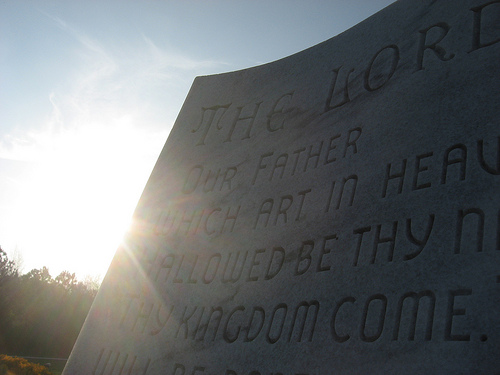
Jesus begins the instruction on prayer (Matthew 6:9-13) by telling his disciples to pray for the Father’s name to be “hallowed,” for his kingdom to come, and for his will to be established on earth as it is in heaven. He is, in effect, telling them to pray for the fulfillment of everything his ministry, and their ministry, is about—glorifying the Father by bringing about the rule and will of God on earth. Such a prayer assumes, however, that the will of God is not being carried out in this present world.
This prayer, then, is a prayer for change, and the change involves moving from a world in which the Father’s name is not honored, his will is not done, and his rule not established, into a world in which these things are as they should be.
This petition is in essence a petition for the arrival of the eschaton, and it has decisive warfare overtones. Jesus is telling his disciples to pray that God’s eschatological reign, effected by the final overthrowing of his cosmic foes, the present world rulers, will be accomplished now.
The same eschatological and warfare significance is found in the petition of the Father to “give us this day our daily bread.” This passage may be implying that the disciples are to rely utterly upon the Father and to trust him for their daily bread as they work to bring about his kingdom rule. However the word “daily” is better translated “tomorrow.” The disciples are being told to pray for the “bread of tomorrow,” referring to the banquet feast planned for the eschaton. It is another way of asking for God’s rule to be established now.
Two points need to be made concerning the next clause, the teaching that we are to ask the Father: “Forgive us our debts, as we also have forgiven our debtors.” First this is not a type of quid pro quo declaration. Jesus is reminding the disciples of their need to forgive in the light of the Father’s forgiveness. He is not teaching the disciples to ask God to condition and proportion his forgiveness on theirs.
Second, the petition is a request that looks ahead to the final judgment. The fatherhood of God in the New Testament is associated with the willingness to forgive, and the full manifestation of this fatherhood, and thus of God’s forgiveness, is understood eschatologically.
The eschatological warfare theme comes out in an especially strong way in the final petition of the prayer: “do not bring us to the time of trial, but rescue us from the evil one.” The word “trial” speaks not of moral “temptation” (cf. NIV) but of trials and hardships. The disciples are not, therefore asking God not to play the role of “the tempter,” something God could never be suspected of doing. They are, rather, asking God to protect them from hardships that accompany their kingdom work.
From whom would they expect such hardships? The closing line of the prayer makes it explicit: “rescue us from the evil one.” Jesus knew that carrying out the Father’s kingdom work would evoke attacks from Satan and his army.
We must understand Jesus to be teaching his disciples to pray not just for protection from satanically inspired trials and hardships in general, but even more fundamentally for deliverance from the fiery end-time trial, or at least for aid in remaining faithful during its terror.
—Adapted from God at War, pages 218-220
Image by cmcgough via Flickr.
Category: General
Tags: Eschatology, Jesus, Kingdom Living, Prayer, Spiritual Warfare
Related Reading

Let’s Remember
In light of the events in the last few days involving attacks on American diplomats in foreign countries (and the ensuing political conflict), let’s remember one thing: Our fight is not with flesh and blood. As Christians, our real enemy is not Libyans or Egyptians or Muslims or President Obama or Governor Romney. Our enemy…

Following Jesus as You
Rachel Held Evans posted an insightful blog today (it was actually a repost from 2011) engaging the problem of discouragement as we encounter various ideals of what it means to be a Christian versus the reality and limitations of our particular lives. I think we all struggle with this at one time or another. Rather…

Paradigm Shift Questions
A couple that was recently introduced to ReKnew and several of my books recently wrote to tell me that they are in the process of embracing the warfare worldview along with the open view of the future. They said that they “realize that these things aren’t minor adjustments but are rather all-encompassing paradigm shifts in…
Sermon Clip: Brain Reign
In this short clip, Greg Boyd discusses the 3 parts to who we are to help understand the brains role. What does role does the mind, body, and spirit play in who we are? In the full sermon we look at the New Testament teaching on reigning over the relational brain. Understanding how God wired…
Sermon Clip: Dear Abby
In this short sermon clip, Greg Boyd discusses Matthew 7. The infamous “plank in your own eye vs a speck of dust in your neighbors. He clarifies what this verse means when you have a close friend with an issue that you are helping them with. In the full sermon of Heart Smart our team…

Following Jesus from the Margins
D. Sharon Pruitt via Compfight Kurt Willems posted a reflection today entitled From the Margins: Following Jesus in a post-Christian culture. I hope everyone will read this. It’s a perspective from the anabaptist tradition that finds inspiration from the same data that evangelicalism finds alarming. May we all follow Jesus from the margins and offer…