
We run our website the way we wished the whole internet worked: we provide high quality original content with no ads. We are funded solely by your direct support. Please consider supporting this project.
What’s the Purpose of the Old Testament Law?
Whereas the old covenant was rooted in the law, the new covenant is rooted in simple faith, such as Abraham had. Whereas the old covenant was forged with one particular nation, the new covenant is available to all who are willing to accept it, regardless of their ethnicity and nationality. Whereas forgiveness of sins within the old covenant was oriented around the repeated sacrifice of animals, in the new covenant God’s forgiveness is offered freely to all and is based on the once-and-for-all sacrifice of God’s own son. Whereas the old covenant motivated people with immediate blessings and curses, this new covenant motivates people by the love of God birthed in their heart through the indwelling Holy Spirit. And whereas the old covenant promised military victory over enemies, this new covenant promises ultimate victory for all who are willing to refuse all violence and instead love and serve their enemies.
If we accept that Jesus reveals what God has always been like, I submit that it is simply impossible to understand the new covenant he inaugurated to be an afterthought on God’s part—a sort of “Plan B,” as it were. The new covenant that was inaugurated by Jesus must rather reflect the way God has always wanted his people to view him, the way God has always wanted people to relate to him, and the way God has always wanted his people to live. This implies, however, that the failure of the old covenant cannot be understood to be an unintended contingent fact of history. But if Jesus reveals what God is really like, God’s decision to replace the old covenant with a new one cannot be understood along these lines.
This point is confirmed by the fact that the NT makes it abundantly clear that God from the start planned on having a “bride” who would be incorporated into his Son. And, at least from the time of the fall, it’s clear that God planned on Jesus giving his life to redeem this bride. This obviously entails that the Incarnation and Crucifixion, together with the new covenant they inaugurated, cannot be viewed as a “Plan B” that God would invoke only if the old covenant, his “Plan A,” failed. We must rather accept that the new covenant was God’s “Plan A” all along, which in turn implies that the failure of the old covenant that led to it was intended by God from the time he decided to enter into it, in response to Israel’s rebellion, on Mount Sinai. It means, in other words, that at least one of the purposes God had for entering into a law-oriented, nationalistic covenant that inevitably involved violence, and therefore one of the reasons he had for condescending to wear the mask of a law-oriented, nationalistic, violent warrior, was precisely to show that this kind of covenant cannot work.
We find a strong confirmation of the understanding of the old covenant as a negative object lesson in the fact that it’s failure was foretold even while it was being given (Deut. 28:37-56). In the midst of a broader narrative in which Moses is stipulating the blessings and curses of the Sinai covenant, he gives a prophecy that goes beyond merely warning people about what will happen if the people stray from the law, such as we find elsewhere. He rather states that God’s people will stray and describes the cursed consequences that will come upon them as a result.
Reflecting God’s displeasure over his people choosing a king in the future, this prophecy begins by announcing that when the Israelites disobey, “The LORD will drive you and the king you set over you to a nation unknown to you or your ancestors” (v. 37). It predicts that the land the Israelites were about to enter would be invaded and destroyed by a multitude of nations “from the end of the earth” and describes how they will be enslaved and mistreated (vss. 48-49, 52). It predicts that the Israelites will become “a thing of horror, a byword and an object of ridicule among all the peoples where the LORD will drive you” (vs. 38). And it ends by foretelling a multitude of horrific “curses” that will “pursue” the Israelites, including their being starved to the point of cannibalizing their own children (53-57). This passage clearly reveals that God forged this nationalistic, law-oriented, violent-prone covenant, with its stipulated blessings and curses, knowing it would not work. And, in light of the manner in which this failure prepared the way for the new covenant that Jesus inaugurated, I submit that this foreknown failure explains why God entered into it. He was embarking on a strategy of negative pedagogy.
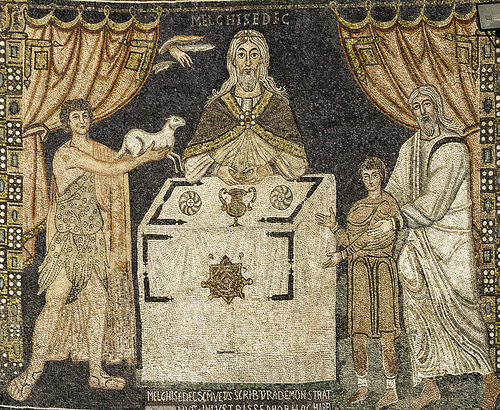
Image by Lawrence OP via Flickr.
Category: General
Tags: Cruciform Theology, Law, Old Testament
Topics: Biblical Interpretation
Related Reading

Overview of Crucifixion of the Warrior God
Greg reviewed the content of his new book, Crucifixion of the Warrior God, as a part of the Woodland Hills Church Covenant Partner gathering on March 5, 2017. If you want a fairly succinct synopsis of the thesis of his book, look no further. Ten years ago, Greg set out to write a book justifying the…

Cruciform Aikido Pt 2: God-Forsaken Judgment
So if Jesus is the supreme revelation of what God is like, as we explained in our last post, what does that tell us about the nature of God’s judgment?
As Jesus was dying on the cross he cried out, “Eli, Eli, lema sabachthani?,” which means, “My God, my God, why have you forsaken me?” (Mt. 27:46). This shocking cry reveals…

Podcast: How Does a Cruciform Hermeneutic Affect Your Reading of Homosexuality Passages?
Greg talks about accommodation, judgement, and homosexuality. http://traffic.libsyn.com/askgregboyd/Episode_0337.mp3

Answering an Objection to a Cross-Centered Approach to Scripture
Through Greg’s Facebook and Twitter, we’ve been getting some great feedback and questions regarding his cross-centered approach to Scripture. Several have voiced questions similar to the reader’s (below), so we thought it would be helpful to post Greg’s answer here on his blog.

One Hope
When Jesus was crucified by his enemies instead of conquering his enemies, the hope of Jesus’ disciples came crashing down in utter despair. They had hoped that Jesus would establish the kingdom of God in the same way that other kingdoms were established. However, the resurrection reveals that the kingdom of God is not like…

Does Paul Condone Vindictive Psalms? A Response to Paul Copan (#1)
In a recent paper delivered at the Evangelical Theological Society, Paul Copan raised a number of objections against my book, Crucifixion of the Warrior of God. This is the first of several blogs in which I will respond to this paper. (By the way, Paul and I had a friendly two-session debate on Justin Brierley’s…