
We run our website the way we wished the whole internet worked: we provide high quality original content with no ads. We are funded solely by your direct support. Please consider supporting this project.
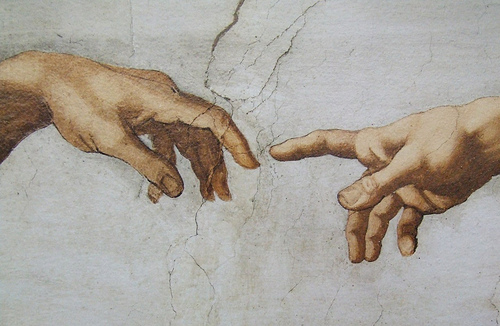
Thou Shalt Not Fear Science
Bev Mitchel is a person I’ve just recently been introduced to. He’s among an increasing chorus of scholars who believe it’s time for Evangelicals to stop being afraid of science and to instead seriously integrate it into our reading of Scripture and theological reflection. Here is a little piece he wrote for Jeff Clarke’s (very informative) website integrating the kind of power God reflects in Christ with the power that creates and sustains the universe. Bon Appétit!
~Greg
Image by gnuckx. Used in accordance with Creative Commons. Sourced via Flickr.
Related Reading

The Beautifully Bizarre Entangled You
Reality is not always what it seems. We get lulled into treating our miraculous lives as something ordinary if we’re not paying close attention. Last weekend Greg preached on some of the more bizarre findings of quantum physics and what this this reveals about how beautifully entangled we are with God and with one another.…
On Biblical Inerrancy
Matthew Kirkland via Compfight In this essay, Peter Enns explains his views on Biblical inerrancy and the complexities encountered as evangelicals attempt to define the term. From the essay: Speaking as a biblical scholar, inerrancy is a high-maintenance doctrine. It takes much energy to “hold on to” and produces much cognitive dissonance. I am hardly…
Greg’s Interview on The Christian Transhumanist Podcast
Here is an interview I did for The Christian Transhumanist Podcast that I wanted to share with all of you. Micah Redding and I discuss everything from Relativity Theory to Politics. I think you’ll find it interesting, but I want to offer a word of clarification before you listen. At one point in this interview…

Glorious Creation
I’m not a scientist, but I’ve always loved to dabble in it. In fact, I collaborated with some friends and wrote a quirky picture book on the interfacing of various areas of science (e.g. quantum theory, chaos theory) and the open view of the future. It’s called The Cosmic Dance and, just to let the…
Hellbound? in the Washington Post
Kevin Miller, the writer/director of “Hellbound?” was featured in the Washington Post in an article titled “Hell is a reality distortion field.” He challenges us to consider that what we believe about hell or anything else is partially conditioned by many things other than just the Bible. This reality distortion field prevents us from considering…

Support for Open Theism from Science and Experience
I have discussed the scriptural support that depicts the future as partially open and that God knows it as such. I do this in God of the Possible. If a position is true, every avenue of reflection ought to point in its direction, including science. What follows are two more “pointers” to the view that the…