
We run our website the way we wished the whole internet worked: we provide high quality original content with no ads. We are funded solely by your direct support. Please consider supporting this project.
Can Bible Imperfections IMPROVE the Reliability of the Bible? (podcast)
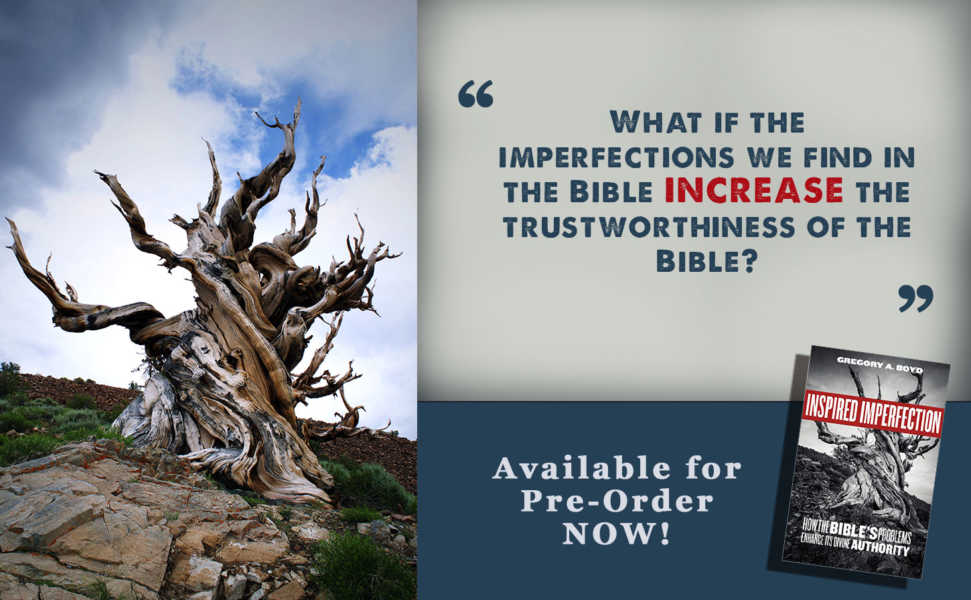
Greg talks about his new book: Inspired Imperfection: How the Bible’s Problems Enhance Its Divine Authority.
Episode 537
Send Questions To:
Dan: @thatdankent
Email: askgregboyd@gmail.com
Twitter: @reKnewOrg
Greg’s new book: Inspired Imperfection
Dan’s new book: Confident Humility
Subscribe:



Related Reading

A Response to “Are Greg Boyd and I Reading the Same Old Testament?”
Collin Cornell has recently published a review of Cross Vision (CV) and, less directly, of Crucifixion of the Warrior God (CWG) in The Christian Century. In this post I will respond to the two major objections Cornell raises against these books. Cornell begins by recounting a discussion I had with a woman who was deeply impacted…

One Hope
When Jesus was crucified by his enemies instead of conquering his enemies, the hope of Jesus’ disciples came crashing down in utter despair. They had hoped that Jesus would establish the kingdom of God in the same way that other kingdoms were established. However, the resurrection reveals that the kingdom of God is not like…

Podcast: How Do You Recommend Reading the Bible to Kids?
Greg looks at reading the Bible to kids and considers where in the Bible one should start reading. http://traffic.libsyn.com/askgregboyd/Episode_0311.mp3

Challenging the Assumptions of Classical Theism
What came to be known as the classical view of God’s nature has shaped the common, traditional way that most people think about God. It is based in the logic borrowed, mostly unconsciously, from a major strand within Hellenistic philosophy. In sharp contrast to ancient Israelites, whose conception of God was entirely based on their…

The Cruciform Beauty of Horrific Divine Portraits
“Only a person who is aware of the crucified Christ can properly understand Scripture.” Luther (Table Talks) In the last three posts I’ve been wrestling with how insights from Matthew Bate’s book, The Hermeneutics of the Apostolic Proclamation might help us interpret violent portraits of God in the OT in a way that discloses how…
How Revelation Uses Violent Images in an Anti-Violent Way
All the violent scenes in Revelation are symbols for the battle of truth and deception. They never involve literal violence. In fact, they symbolize ANTI-VIOLENCE. The ingenious way John helps us get free of deception of trust in violent power is by taking a standard violent symbol and juxtaposing it with a symbol that undermines…