
We run our website the way we wished the whole internet worked: we provide high quality original content with no ads. We are funded solely by your direct support. Please consider supporting this project.
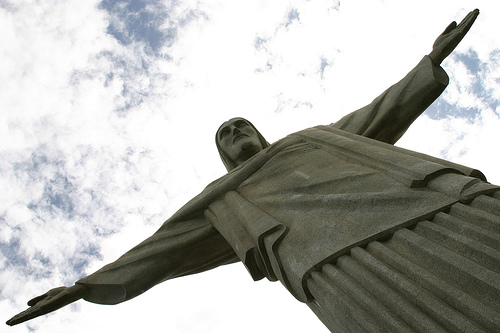
Giant Jesus
Yesterday’s post featured a video of Greg sharing about the role of the church in manifesting God’s character to the world. Here are some follow-up thoughts on that topic.
The NT often uses the metaphor of “the body of Christ” to describe the church. When Jesus walked the earth, he did so in an ordinary body, beginning with his birth in Bethlehem. Now he does not physically walk the earth, but the Church is his hands, mouth, and feet operating in the world today. The same life that was in his first body is in us, his second body. And we who belong to this second body take our marching order from the same “head” as Jesus’ first body.
This is why Luke begins Acts, which is a basic history of the early church, by reminding us that he wrote about Jesus in his gospel by saying “I wrote about all that Jesus began to do and to teach until the day he was taken up to heaven (Acts 1:1). To say that Jesus “began” to do certain things in his incarnate form implies that Jesus is now continuing to do certain things in a corporate form—through his Church.
In Luke’s mind, his Gospel was about what Jesus did through his first body, while the book of Acts is about what Jesus continued to do through his second, corporate body.
Luke sees the Church as a kind of giant Jesus.
In the book of Acts you can also see that Jesus identified with his corporate body. When Jesus knocked Paul off his horse on the road to Damascus, he identified himself as “Jesus, whom you are persecuting” (Acts 9:4). Since Jesus had ascended to heaven several years earlier, how could Paul be persecuting him? Clearly, he was doing so by persecuting the Church. Jesus apparently considered whatever happened to the Church as happening to him. Pain inflicted on his Church is pain inflicted on his body, as much as when spikes were driven into his hands and feet on the cross.
Paul wrote that we are to be “imitators of God” (Eph 5:1). The word for “imitate” (mimetai) literally means to “mimic” or to “shadow.” We are to imitate God’s every move, just as Jesus did.
Paul then fleshes out what this mimicking looks like in the following verse: “Live in love … as Christ loved us and gave himself up for us.” The body of Christ is to love others just as Christ loved in his own body, dying on Calvary for sinners.
The call to imitate Jesus is not something we can carry out with our own efforts. It’s a call to yield to the Spirit and thereby manifest the truth that Christ himself is working through us. He is transforming us into his image. He is working through his corporate body to carry out the work he began when he walked the earth.
In this way, we are a giant Jesus.
—Adapted from The Myth of a Christian Religion, pages 18-19.
Photo credit: iko via VisualHunt / CC BY-NC-ND
Category: General
Tags: Church, Discipleship, Incarnation
Topics: The Church
Related Reading

Feeding Our Hungry Hearts
Jesus came into a world that was full of hungry hearts (see previous post) to introduce us to the only thing that can feed those hungers. Jesus came to rescue us from the futile feeding frenzy of trying to feed ourselves on idols. Throughout the Bible, we read story after story of people trying to…

A Brief History of Political Power and the Church
The history of the church has been largely one of believers refusing to trust the way of the crucified Jesus and instead giving in to the very temptation he resisted. It’s the history of an institution that has frequently traded its holy and distinct mission for what it thought was a good mission. It is…

Jesus & Racial Reconciliation
Lorenia via Compfight If you were to read an account today of a white man offering his front row seat on a public bus to an elderly African American lady, you’d probably think this was a nice gesture, but nothing more. However, if you learned that the event happened in Birmingham Alabama in 1955, you’d…
Is Open Theism Incompatible With a Chalcedonian Christology?
Question: The Chalcedonian Creed says Jesus was “fully God and fully human” and that these “two natures” remained distinct in the Incarnation, even though Jesus was one united person. I’m told that part of the reasoning behind the concern to keep Jesus’ humanity distinct from his divinity was to protect the “impassibility” of the divine…

Should churches have armed security guards?
Question: Recently (December, 2007) a security guard at New Life Church in Colorado Springs shot and apparently killed a man who was shooting people in the church parking lot. The pastor (Brady Boyd) hailed her as a “real hero.” Do you think churches should have armed security guards and do you think the pastor was…