
We run our website the way we wished the whole internet worked: we provide high quality original content with no ads. We are funded solely by your direct support. Please consider supporting this project.
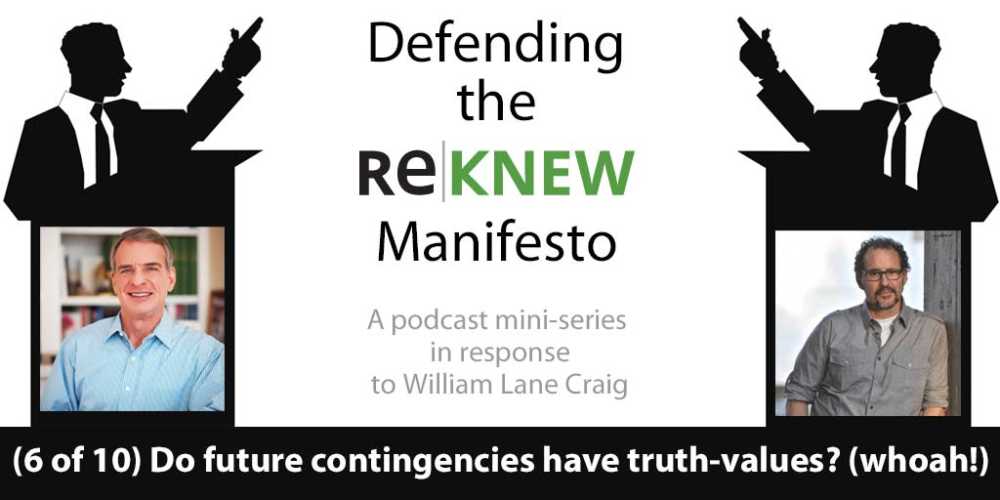
Podcast: Defending the Manifesto (6 of 10)
Greg responds to challenges by William Lane Craig from Craig’s podcast “Reasonable Faith.“
Greg denies Molinism and discusses the logic of possibility.
Send Questions To:
Dan: @thatdankent
Email: askgregboyd@gmail.com
Twitter: @reKnewOrg
Greg’s new book: Inspired Imperfection
Dan’s new book: Confident Humility
Subscribe:



Category: ReKnew Podcast
Tags: Future, Molinism, Open Future, Open Theism
Related Reading
What is the significance of Judges 10:13–16?
The Israelites cry out to God because of their oppression from foreign rulers. The Lord refuses to deliver them because they have abandoned him (vs. 13–14). The Israelites repented, put away their foreign gods and worshipped the Lord. The Lord “also could no longer bear to see Israel suffer” (vs. 16). Hence the Lord changed…
How do I avoid feeling like God is absent?
Question: I used to see God involved in everything and used to believe every event expressed God’s will. After my wife and I lost our child in a tragic accident, and as a result of reading your books (especially Is God to Blame?), I came to embrace the warfare worldview and the open view of…

Can Science Inform Our Theology?
Over the last century, we have witnessed a revolution in various areas of science that relate to how we see the world and even God. For example, the Platonic notion that time and change are less real than timeless stability is being abandoned in light of the fact that physicists work from the assumption that…

An Omni-Resourceful God
It is quite common for us to talk about the attributes of God as omnipotent (all-powerful), omniscient (all-knowing) and omni-present (present everywhere), but what about God’s unlimited resourcefulness? Consider the story of Moses’ commission in Exodus 3 and 4. Here the Lord instructs Moses to tell the elders of Israel that the Lord has heard…

Podcast: Is an Open Future World a Logically Possible World?
Greg gets technical in this abstract, yet profound, introduction to an open theist’s interpretation of the square of opposition. http://traffic.libsyn.com/askgregboyd/Episode_0217.mp3
How can you put your trust in a God who’s not in control of everything?
Question: I read your book Is God to Blame? and found it to be very compelling. It’s rocking my world. But I’m also finding I’m now having trouble trusting God like I used to. I used to believe that God ordained or at least foreknew all that was going to happen. Now I’m questioning this,…