
We run our website the way we wished the whole internet worked: we provide high quality original content with no ads. We are funded solely by your direct support. Please consider supporting this project.

Jesus’ Kind of Social Justice
For many, the primary way of building the kingdom is to influence politics in order to make America more Christian. Others take the opposite approach, concluding that Jesus didn’t try to overhaul the political systems of his day through political means; therefore Christian faith is only a private matter that has no social relevance. Both approaches get it wrong.
Because Jesus did not allow the society or politics of his day to define his ministry, he positioned himself to make a revolutionary prophetic impact upon his society and the politics of the time. Jesus did not buy into the limited options the culture placed before him. He rather exposed the ugly injustices in all kingdom-of-the-world options by offering a radically distinct alternative.
For example, Jesus never entered into the fray of particular debates about the status of women in society. He rather exposed the ugliness of patriarchalism by the countercultural way he treated women. Ignoring negative consequences for his reputation, Jesus befriended them and gave them a culturally unprecedented dignity.
In a similar way, Jesus did the same for social outcasts. He served lepers, the blind, the demonized, the poor, prostitutes, and tax collectors. His actions were a challenge to the inhumanity of social structures of the day that served as a mustard seed alternative that started small but grew slowly.
Jesus also exposed the inhumanity of certain religious rules, which was a political problem in the first century because religious leaders had political power. He exposed the evil of racial prejudice by fellowshipping with Samaritans and Gentiles, and he even praised them in his teachings. In addition, he healed and worked miracles on the Sabbath, something that religious leaders forbade.
Finally, Jesus exposed the barbarism of the Roman government by allowing himself to be crucified by them. Instead of using his power to preserve his life, he exercised the power of love by giving it.
The power of the kingdom is not one where Christians aim to attain “power over” like the kingdoms of the world. Instead, we exercise “power under.” We therefore must resist the demonic pull toward “power over” violence that characterizes all versions of the kingdom of the world. “Power under” unmasks the ugly injustice and violence that dominates our political and social systems and doesn’t wage war “against flesh and blood” but instead fights against “rulers, against authorities, against cosmic powers of this present darkness (Eph 6:12).
It is a beautiful kingdom that is not so much spoken as it is displayed through loving action.
Jesus called the church to be a community characterized by radical, revolutionary, Calvary-quality love: a community that manifests the love of the triune God; a community that strives for justice not by conquering but by being willing to suffer; a community that God uses to transform the world by providing it with an alternative to its own self-centered, violent way of existing.
How socially and politically revolutionary it would be if we lived up to our calling!
—Adapted from The Myth of a Christian Nation, pages 119-122
Category: General
Tags: Justice, Political Idolatry, Politics, Social Issues
Topics: Ethical, Cultural and Political Issues
Related Reading

Why do you argue that discipleship and politics are rooted in opposite attitudes?
Question. At a recent conference I heard you argue against the idea that there could ever be a distinctly “Christian” political position by contending that political disputes are premised on a claim to superiority while discipleship is fundamentally rooted in humility. I don’t think I get what you mean. Can you explain this? Answer: In…
Jesus and Democracy
Question: I’ve heard that the reason Jesus didn’t speak up on political issues was because he didn’t have the benefit of living in a democracy. Since we do, don’t we have a duty both to God and our country to be involved in politics? Answer: If the reason Jesus didn’t speak up on political issues…

Election Benediction
On this election day, when so many Americans are experiencing high levels of anxiety, I thought it would be good to share an “Election Benediction” that was written and sent to me by Kenneth Tanner. Let it ground you in the love, peace and security of Christ and his Kingdom. An Election Benediction By Kenneth…
Hate-Filled Prayers
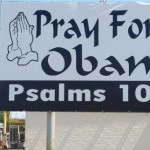
I came across a story about this billboard at 4:00 yesterday morning and tweeted on it. It would be easy to dismiss this sad display as an isolated act of a crazed fanatic, but I think it actually symbolizes the demonic animosity that permeates our current political climate. In fact, this is the third time…
The Life and Death of MLK and What it Might Have to Say to Us
Tony Fischer via Compfight Here is an EXCELLENT reflection from Jonathan Martin in answer to a question that was posed to him on how he reconciles his rejection of the politics of this world with the social justice work of MLK. This is a must read. From the article: So to come to the question,…