
We run our website the way we wished the whole internet worked: we provide high quality original content with no ads. We are funded solely by your direct support. Please consider supporting this project.
Thinking Theologically
In a previous post, I challenged the common notion that the Scripture is the foundation or the center of our faith. Instead, it’s my conviction that the only place to begin is Jesus Christ. Paul says that Jesus Christ is the foundation” (1 Cor 3:11). And Peter proclaimed that Jesus is the “cornerstone” that “the builders rejected (1 Pet 2:6-7), which means that the entire edifice of the Christian faith is to be built upon him. The Bible is not that center, but it actually points to the center of our faith, Jesus. This was the confession of the early Church Fathers. “[T]he standing message of the Fathers to the Church Universal,” writes Georges Florovsky, was that “Christ Jesus is the Alpha and Omega of the Scriptures both the climax and the knot of the Bible.”
We must adopt Paul’s humble mindset and start with the confession that we “know nothing … except Jesus Christ and him crucified” (1 Cor 2:2). From beginning to end our thinking about God, our theological beliefs and even our interpretation of Scripture should be centered on the crucified Christ. As Karl Barth brilliantly emphasized throughout his Church Dogmatics, and as Thomas Torrance has more recently clearly elucidated in a number of writings, Jesus is not one of God’s words; Jesus, as the God-become-human, is the Word to which all the words of Scripture bear witness. As such, we should regard him to be the essential content and ultimate purpose of all “God-breathed” words.
With the center of Christ, all other beliefs can be assessed according to their relative importance to that starting point of Christ. Instead of weighing all beliefs on a level plain, I envision three concentric circles surrounding that center. The proximity of each circle to the center reflects its relative importance.
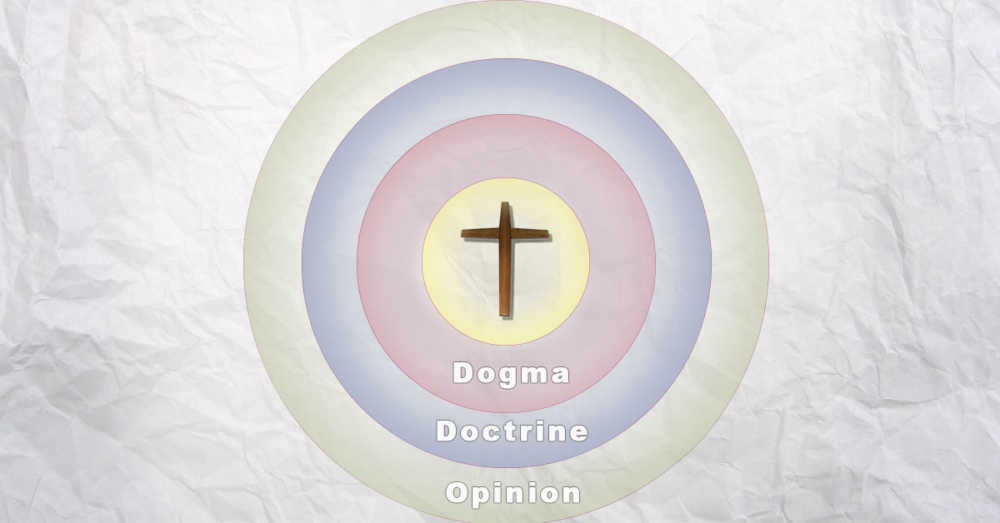
In the first circle out from Christ is what I call Dogma. In this ring are those beliefs that have traditionally been understood to constitute orthodox Christianity, which are reflected in the foundational ecumenical creeds. The belief that God is a Trinity, that Christ is fully God and fully human, and that the world is created and governed by God are examples that we find here.
The second circle is called Doctrine. These are beliefs that orthodox Christians have always espoused, but over which there has been some disagreement. These are different doctrines that distinguish various denominations. For instance, while orthodox Christians have always believed that God governs the world, there are a variety of ways of stating how God does this. You might check out my book co-authored with Paul Eddy called Across the Spectrum to see some of the ways that people hold different Doctrines.
I call the third ring Opinion. Here I place beliefs that individual Christians have occasionally espoused but have not gained widespread support. One might, in other words, claim that my proposal in Crucifixion of the Warrior God falls in this category and is offered to invite further conversation about it. While the ring called Doctrine is comprised of different ways Christians have interpreted Dogma, this third ring usually comprises different ways of interpreting particular Doctrines.
There is plenty of room for different ways of applying this way of thinking theologically. While the church might uniformly agree on that which constitutes Dogma, some will see certain beliefs that should be labeled as Doctrine, while others will argue that they are Opinion. But the most important aspect of this model is that it articulates the fact that not all beliefs are equally important while making it clear that everything revolves around the starting point of our theology: the crucified Christ. This is the center of our theology and all of our theological reflection.
—Adapted from Benefit of the Doubt, pages 170-173
Category: General
Tags: Cruciform Theology, Friendly Disagreements, Heresy
Related Reading

If the violent depictions of God in the Bible are not completely accurate, isn’t all of Scripture up for debate?
Question: I’m very intrigued by your cruciform hermeneutics and can’t wait for your book (Crucifixion of the Warrior God) to come out. But I have to say that it strikes me as dangerous. You’re basically saying that the violent portraits of God in the OT are not completely accurate. But doesn’t this place us flawed…

Podcast: What Do We Do When the Bible Sends Mixed Messages?
Greg considers how to interpret mixed commands in the Bible—where one verse advises differently than another. http://traffic.libsyn.com/askgregboyd/Episode_0364.mp3
Four Principles of the Cruciform Thesis
In the second volume of Crucifixion of the Warrior God, I introduce how four dimensions of the revelation of God on the cross (as introduced in this post) lead to four principles that show us how to unlock aspects of the OT’s violent divine portraits and thus disclose how a given portrait bears witness to…

Why Are Jesus’s Parables So Violent? (podcast)
Greg pops the hood to offer a helpful tutorial on how parables operate. Episode 609 http://traffic.libsyn.com/askgregboyd/Episode_0609.mp3

Podcast: Does the Cruciform Hermeneutic Sabotage Open Theism?
Greg plays Peek-a-Boo with God and considers whether those verses Open Theists use to support Open Theism might simply be times when God is accommodating for us. http://traffic.libsyn.com/askgregboyd/Episode_0236.mp3

Divine Accommodation and the Cross: where Calvin was onto something
Over the last few posts, I’ve been arguing that the cross represents the thematic center of everything Jesus was about. Hence, rather than striving to have a “Christocentric” theology — which is so broad it means next to nothing—we ought to sharpen our focus by striving for a “cruciform” theology. I then offered some suggestions…