
We run our website the way we wished the whole internet worked: we provide high quality original content with no ads. We are funded solely by your direct support. Please consider supporting this project.
Can you have an Anabaptist Mega-Church?
Several times over the last few years I’ve heard statements like this: “Boyd may embrace an Anabaptist theology, but his church (Woodland Hills) cannot be, by definition, an Anabaptist church because an Anabaptist church can’t be a mega-church.” I’ve heard similar things about our sister church, The Meeting House, in Toronto Canada. The reasoning behind these statements seems to be that in Anabaptist theology, the church is a community of disciples who model the love of God to the world by how they love one another and share life together. Moreover, Anabaptist theology has always stressed that spiritual maturity is impossible apart from the discipline of living in community with other disciples. This is impossible to do with a group of mostly strangers who gather together to listen to a sermon and worship together once a week. Unless a group of people are doing the fifty-seven “one another’s” that are commanded in the NT (e.g. “love one another,” “submit to one another”), the group is not a “church” by the standards of Anabaptist theology (and, I would add, by the standards of the NT).
Ironically, those who argue mega-churches can’t be Anabaptist churches are assuming, in the process of raising this objection, a non-Anabaptist definition of church as a weekend gathering. If the leadership of Woodland Hills thought that our “mega” weekend gathering was “the church,” the objection would indeed be valid. But we don’t think this, precisely because this would be a very non-Anabaptist position to assume!
We rather view our “mega” weekend gathering to be nothing more than that – a weekend gathering. It’s a large event that provides us with an opportunity to teach the Gospel and to begin to make disciples by drawing weekend attenders into our much smaller house churches. The event, therefore, isn’t the church, but simply a means of building the church. In this sense, it would be more accurate to see Woodland Hills as a network of house churches that happens to have a “mega” week event than it is to see us as a mega-church.
At Woodland Hills, our house churches consist of groups of 30 or so people from the same region who gather together on a weekly basis for several hours for fellowship, worship and ministering to one another and who meet with two or three others once a week for the purpose of discipleship and accountability. Some folks in these house churches continue to attend the weekend event while others do not, and the leadership of the church is okay with this either way so long as a person’s participation in the house church and accountability groups is not compromised.
The point I’m making goes far beyond the question of whether or not a mega-church can be considered Anabaptist. Multitudes of people today are beginning to realize that the kingdom is about forming passionate disciples who live in authentic community with one another, not about attracting a large crowd to a weekly event. As people wake up to this truth, many are beginning to distain the mega-church phenomenon. In fact, I’ve heard of several pastors of mega-churches who woke up to the true nature of the church and who have consequently either resigned from their churches or who have simply shut their churches down. I for one think this unfortunate, for you’re forgoing an opportunity to influence a large group of people in the direction of the kingdom.
What Woodland Hills Church (as well as and the Meeting House in Toronto and other mega-Anabaptist Churches that may be out there) demonstrates is that we don’t have to chose between embracing the church as community, on the one hand, and holding a large weekend gathering, on the other. There’s nothing intrinsically anti-kingdom about large gatherings. After all, large crowds flocked to Jesus, and the early Christians in Jerusalem met in large groups in “Solomon’s porch” (Acts 5:16-19). The key, however, is to always remind people that the primary expression of church is not the large group, but the smaller communities that come together in houses to share life, study the word, worship and minister together.
So, I would argue that you can have a mega-Anabaptist church, but only if you continually proclaim that the church is not defined by the “mega” weekend event, but by the authentic kingdom communities you create out of this event.
__ __ __
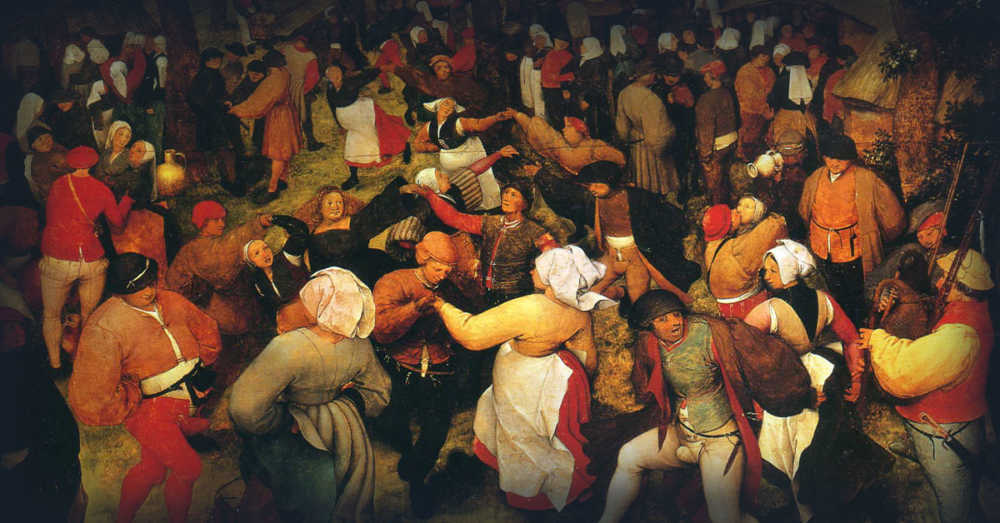
art: “The Wedding Dance in the open air”
by: Pieter Bruegel the Elder
date: c.1566
Category: General
Tags: Anabaptists, Community, House Churches, Kingdom Living, Mega-Churches, The Meeting House, Woodland Hills Church
Topics: The Church
Related Reading

If you really want to defend the poor from Caesar, shouldn’t we use the political means that exist? It’s easy to make your argument when you are in a position of privilege.
Question: I’ve been reading your blogs for a while. I’ve read multiple texts written by you and it’s difficult to listen much longer as someone in poverty. It’s easy to make your argument when you are in a position of privilege. The Church doesn’t have the power and resources to help the poor everywhere. Christians…

Our Sacred Scared
Tom Lin via Compfight Glennon Doyle Melton is the voice behind Momastery. She is a brave, funny and challenging writer who has decided to tell the truth after years of drug and alcohol abuse and bulemia. Recently, Glennon has invited a series of men and women (including Rachel Held Evans, Jamie the Very Worst Missionary,…
Be the Change Now
Ghandi once said, “Be the change you want to see in the world.” It’s a profoundly Kingdom teaching. It seems to me, however, that few people adopt Ghandi’s philosophy. It’s far easier to focus our attention on how others should change. It’s far easier to spend our energy assigning blame for the problems of society…

The Right to Remain Silent
A reader (Thanks Adam) sent us this reflection written by Jason Hess on how we as Christians sometimes use the freedom of speech in ways that are in opposition with our call to love. How we live is infinitely more important than what we say, and sometimes our free speech is a detriment to bringing…

Podcast: Is It Important to Live Near Your Small Group?
Greg on living life together. http://traffic.libsyn.com/askgregboyd/Episode_0271.mp3

What is the Kingdom of God (Part 1)
We all know what the Kingdom of God is, right? But this is precisely the problem. Since we are all to a large extent products of our culture, what seems obviously true and right to us will be at least influenced, if not determined, by what seems obviously true and right to our culture. This,…