
We run our website the way we wished the whole internet worked: we provide high quality original content with no ads. We are funded solely by your direct support. Please consider supporting this project.
Thank You Obama for Denouncing “Christian” Violence: It is Actually Far Worse Than ISIS
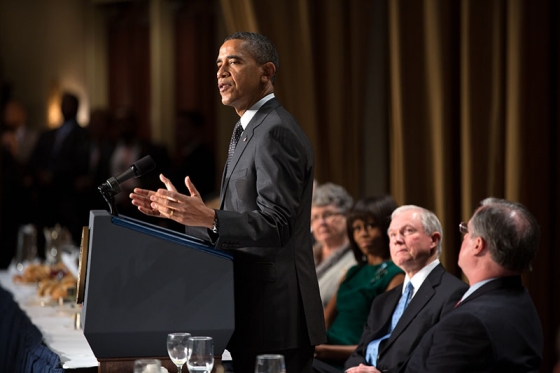
Picture Credit: Official White House Photo by Pete Souza
It seems some conservative Christians are up in arms because of something Obama said at the National Prayer Breakfast yesterday. After condemning ISIS and religiously-motivated violence in general, the president added:
Lest we get on our high horse and think this is unique to some other place, remember that during the Crusades and the Inquisition, people committed terrible deeds in the name of Christ.
How could that possibly be controversial, you ask? Well, according to the Catholic League’s Bill Donohue, it was “an attempt to deflect guilt from Muslim madmen.” He went on to argue that Christian crusaders were merely defending themselves against hostile Muslim neighbors. Conservative commentator Michelle Malkin Tweeted, “ISIS chops off heads, incinerates hostages, kills gays, enslaves girls. Obama: Blame the Crusades.” And there are a host of others expressing their anger over Obama’s comment in various social media venues as well.
Several points. First, Obama didn’t blame the Crusades for what ISIS does. He was simply noting that religious violence isn’t restricted to über-radical Muslims, and he was right to do so.
Second, the crusaders were most definitely not merely “defending themselves against hostile Muslims!” There is a reason why they were called “crusaders” rather than “defenders.” They traveled from Europe down to the Holy Land because they wanted to take it from the Muslims. And as Muslims and “Christians” fought over this land for the next two centuries, “Christians” were at least half the time aggressors.
Third, the crusaders were sometimes just as vicious as Isis. One account I read reported that the crusaders celebrated a particular victory over their Muslim adversaries by throwing their babies in the air to impale them on their swords!
Fourth, the Inquisition was even worse than the Crusades. “Christians” in the Middle Ages developed ingenious ways of torturing people. Hundreds of thousands of Jews, witches, heretics, and rank and file sinners were tortured and murdered in ways that would make ISIS warriors green with envy. (If you have the stomach for it, check out this.)
Finally, and most importantly, why on earth would any follower of Jesus want to minimize or defend the atrocities committed in the name of Christ? I rather think we have an obligation to denounce it in the strongest terms possible, for this violence completely contradicts everything Jesus stood for and died for. Insofar as people tortured and killed in the name of Jesus, they have no more in common with the real Jesus and the real kingdom he inaugurated than ISIS does, and, for the sake of Christ, his followers need to declare this.
In fact, for followers of Jesus, the violence perpetrated by “Christians” throughout history ought to be considered far worse than the violence perpetrated by ISIS or any other religious group throughout history, precisely because this violence was done in the name of Jesus. Whereas other forms of religious violence harm people, Christian violence also brought – and still brings – tremendous harm to the kingdom of God. While the church is supposed to attract people to Christ by the beauty of our Jesus-imitating self-sacrificial love, violence in Jesus’ name drives people away and justifies their hatred and unbelief.
For this reason, violence done in Jesus’ name must be considered by Jesus followers to be the most demonic form of violence there is. As demonic as the violence being carried out by ISIS is, “Christian” violence is much more so.
So thank you President Obama for including Christian violence in your denunciation of religious violence—though you could have worded it much more strongly!
Category: General
Tags: Crusades, ISIS, Non-Violence, Obama, The Inquisition, Violence
Related Reading

Violent Thinking
When most people think of violence, they think of physical violence. But the truth is that our actions are only violent because our hearts and minds are violent first. For this reason, Jesus emphasizes purging violence from our minds as much as from our physical behavior. In Matt 5:21-26, he reminds us of the OT…

Should churches have armed security guards?
Question: Recently (December, 2007) a security guard at New Life Church in Colorado Springs shot and apparently killed a man who was shooting people in the church parking lot. The pastor (Brady Boyd) hailed her as a “real hero.” Do you think churches should have armed security guards and do you think the pastor was…
The Good Samaritan, Non-Violence & Eternal Life
Renaud Camus via Compfight An expert in the law asked Jesus what he had to do “to inherit eternal life” (See the story in Luke 10:25 and following). Jesus asked him what he thought the law said about this issue. The man responded, “’Love the Lord your God with all your heart and with all…
Take America (& the World) Back for God?
Kai Schreiber via Compfight Recently Missio Alliance has hosted a series of posts entitled “Christianity and Violence.” Since Greg has written quite a lot on this topic from the point of view of pacifism, we thought it timely to weigh in on this topic. The following excerpt is quoted from his chapter, “Taking America Back…

The Radically Distinct Kingdom of God
Yesterday, we posted a video where Greg mentioned the radical distinction between the kingdom of God and the governments of the world. The following explains this distinction further. Nothing is more important to the cause of the kingdom of God than actually living out a Christlike vision of the kingdom. Or to put it in…

Caught Between Two Conflicting Truths
In my previous blog I tried to show that adopting a “Christocentric” approach to Scripture isn’t adequate, as evidenced by the fact that people adopting this approach often come to radically different conclusions. In fact, it seems to me that the “Christocentric” label is often close to meaningless inasmuch as it doesn’t meaningfully contrast with anything. If a “Christocentric”…