
We run our website the way we wished the whole internet worked: we provide high quality original content with no ads. We are funded solely by your direct support. Please consider supporting this project.
Kingdom Reconciliation is Not About Politics (But it is Political)
In the broader culture, the social and political discussions about racial reconciliation are usually focused on people’s rights and privileges as a means of making the world a fairer place. The criteria such efforts at reconciliation appeal to are common decency, fairness and reason. The enterprise is certainly necessary, and all decent, fair minded, rational people should obviously pursue it.
Yet, the quest for the reunification and reconciliation in the kingdom is quite different from this. Our goal as kingdom people isn’t first and foremost about equalizing privilege and power. We are called to manifest the “one new humanity” Jesus came to create. And the means to attaining this goal isn’t focused on personal rights and a fair distribution of power. Instead we focus on on confronting the oppressive principalities and powers by our willingness to imitate Jesus and sacrifice our rights and power.
At the same time, while the Kingdom is not of this world (Jn 18:36), it can never be isolated from the world. Indeed, we are called and empowered by the Spirit to ultimately transform the world. The way we are to do this is not by presenting ourselves as experts on what the broader society should do, but by simply bearing witness to the Lordship of Christ and the “one new humanity” he is in the process of bringing about. Manifesting the beauty of a reconciled humanity under the Lordship of Christ and revolting against the powers that keep humanity fragmented is our unique service to the world.
We do this by:
- Displaying what it looks like when people are free to sacrifice their advantages in society for those whom the racially structured society disadvantages.
- Being freed of the idols of race, culture and nationality while embracing the diversity of races, cultures and nationalities in our world.
- Revealing the beauty of a reunified and reconciled race in which all people are willing to set aside their rights and sacrificially serve one another.
The hope of the world lies not in kingdom people being politically smarter than people in the broader society, but in kingdom people simply being faithful to their call to imitate the cross-like love of Jesus and thereby manifest God’s beauty in the world. We put our hope in God that he will use this simple, often unseen, work to drive out the ugliness of racial division in our world.
Somewhat ironically, when we manifest the beauty of God’s kingdom and revolt against the ugly powers that shape our culture, we in one sense can’t help but be profoundly political. Precisely because he was the incarnation of God’s kingdom, Jesus refused to conform to laws and social norms that were inconsistent with the will and character of God. In doing this, he was making a profound political statement. We are called to do the same and therefore to be political in this same way.
We are to obey our government and live in peace with the broader society insofar as this is possible (Rom. 12:18, 13:1). But insofar as obeying government and conforming to social norms violates our integrity as kingdom people, we have no choice but to revolt. As Peter said, “we must obey God rather than any human authority” if and when the two come in conflict with one another (Acts 5:29). And to do this, as I said, is to make a profound political statement.
Along similar lines, as citizens of God’s kingdom we are called and empowered to manifest a Christ-like willingness to set aside whatever privilege the social system has granted us and enter into solidarity with those oppressed by this system. Following the example of the one who laid aside his privilege and took on our humanity and oppression, we who are not racially oppressed are to consider the plight of racially oppressed people to be our own plight. When they hurt, we are to hurt.
This too can’t help but make a strong political statement. Among other things, when kingdom people in large numbers cry in pain in solidarity with the oppressed, it makes it much harder for the power brokers of the society to ignore these often voiceless people. We don’t have to pretend that we kingdom people have uniquely wise solutions to political problems in order to lament with those who are in pain.
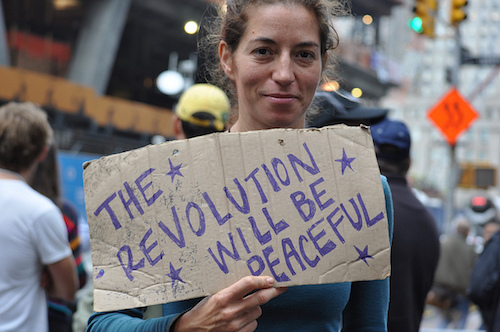
To stand against the principalities and powers inevitably involves revolting against the oppressive worldly systems they pollute. It’s just that our unique way of revolting doesn’t involve being co-opted into the political machinery and playing by their rules. Following Jesus’ example, our way of revolting rather involves refusing to play by their rules while manifesting a beautiful, alternative kingdom.
Photo credit: editrrix via Visualhunt.com / CC BY
Category: General
Tags: Kingdom Living, Kingdom of God, Politics, Racial Reconciliation, Revolt
Topics: Ethical, Cultural and Political Issues
Related Reading

Introducing “TribeNet”
Hello Kingdom people, For years I’ve heard on a regular basis from individuals and small groups/house churches who wanted to know if there are others in their area that share their vision of a Jesus-looking God raising up a Jesus-looking people to transform the world in a Jesus kind of way. Along the same lines,…

Why the Rapture is a Bad Idea
Is the Rapture really what you think it is? Most Christians believe that God will take his followers up to heaven before the really bad stuff starts on earth, but is this what the bible says? Is this view consistent with the loving God that Jesus shows us in the New Testament? View the full…

Q&A: Already-Not-Yet
Question: My question is regarding our “entanglement” with Christ that you spoke about a few weeks ago. In the sermon you noted how we are joined with Christ like those two particles that can be separated by light years of distance and yet both will react equally to a force acting on the other one. So here is my question: If…

Approaching Chronic Illness with Wisdom
CNN posted this article on what to say and what not to say when someone you love is suffering with chronic illness. Sometimes our best intentions cause more harm than good, and we need to approach people in pain with a great deal of wisdom and sensitivity. From the article: When people we care about…

homosexuality, truth telling, and love
A Guy Taking Pictures via Compfight A couple weeks ago, we posted a portion of Greg’s sermon (and his comments) on the marriage amendment in Minnesota, homosexuality and finding a “Third Way”. Today we’re continuing the conversation by linking to a blog post by Sarah Bessey called In which I tell you the truth about…

The Problem with “Church”
Many people think of church as a religious building people attend once a week to sing, hear a sermon, take an offering and perhaps participate in the Lord’s Supper (or “take Communion”). Many refer to the church as “the house of the Lord,” imagining that God is more present in this sacred building and during church…