
We run our website the way we wished the whole internet worked: we provide high quality original content with no ads. We are funded solely by your direct support. Please consider supporting this project.
The Coming Kingdom & Racial Conflict
In the book of Revelation, we see a glimpse into the future. John says he saw,
…a great multitude that no one could count, from every nation, tribe, people and language, standing before the throne and in front of the Lamb. They were wearing white robes and were holding palm branches in their hands. And they cried out in a loud voice:
“Salvation belongs to our God,
who sits on the throne,
and to the Lamb.” (Rev. 7:9-10)
While Satan is at the present time able to deceive the nations and exercise authority “over every tribe, people, language and nation” through the governments he rules (symbolized by “Babylon”) John sees that when the Kingdom is fully come Satan shall be defeated and Christ shall reign as “King of the nations.” Then people from all the scattered tribes will be brought back together to worship him (Rev.15:3-4). The kingdom of Satan will then become “the Kingdom of our Lord and his Messiah” (Rev. 11:15).
Not only this, but John elsewhere says that in this future age all the nations will walk by the light of the New Jerusalem, which is nothing other than the light of God himself (Rev. 21:24). So too, all the unique “glory and honor of the nations” will be brought into this heavenly city (Rev. 21:26) while a tree of life will be present “for the healing of the nations” (Rev. 22:2). All the tribal, phenotypic and cultural differences that caused so much conflict and strife in the post-Babel world will at this time be brought together to magnificently display the glory of God.
The full manifestation of this beautiful reunited and reconciled humanity lies in the future. But Kingdom people are to be the “first fruits” of the coming harvest. We have been chosen “as the first fruits for salvation through sanctification by the Spirit” (2 Thess 2:13). We have been given a new birth so that we “would become a kind of first fruits of his creatures” (Ja 1:18). We who “follow the Lamb wherever he goes” are “redeemed from humankind as first fruits for God and the lamb” (Rev. 14:4).
We’re the consecrated sign of the harvest that lies ahead. We’re to be the “tribe of the future,” manifesting in the present all that will be true in the future.
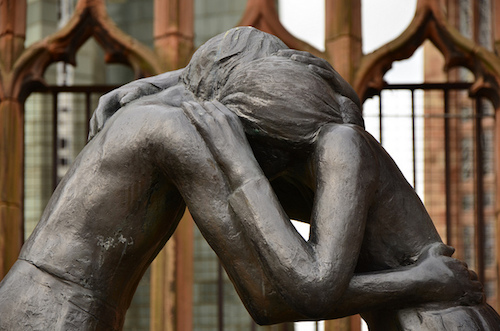
Someday people from every tribe and tongue will be united around the throne of Christ. Our job, therefore, is to manifest this now. Someday the “one new humanity” (discussed in this post) that Jesus established will be perfectly displayed. Our job is to manifest this now. Someday the racial division that began with the tower of Babel (see this post) will be entirely reversed and differences among various people groups will be celebrated as displaying the multifaceted beauty of God rather than despised as the basis for conflict. Our job is to do this now.
This is how we revolt against the principalities and powers that fuel the ugly divisions of humanity and move the world toward the full manifestation of God’s beautiful Kingdom.
Photo credit: Ben Sutherland via Visual Hunt / CC BY
Category: General
Tags: Kingdom Living, Kingdom of God, Love, Racial Reconciliation, Unity
Topics: Ethical, Cultural and Political Issues
Related Reading

Conservatives and Liberals in the Same Kingdom
Jesus did not allow the world to set the terms for what he did. For instance, he called Matthew, a tax collector, as well as Simon, a zealot, to be his disciples. Tax collectors were on the farthest right wing of Jewish politics, zealots on the farthest left. In fact, zealots despised tax collectors even…

The Cosmic Scope of Spiritual Warfare
Yesterday’s post briefly introduced the reality that we live in the midst of spiritual warfare. This is the reality of being a part of creation where Satan prowls like a roaring lion (1 Pet 5:8-9). The Scriptures make it clear that all of creation is in need of redemption. While most Christians assume that the…

The Radically Distinct Kingdom of God
Yesterday, we posted a video where Greg mentioned the radical distinction between the kingdom of God and the governments of the world. The following explains this distinction further. Nothing is more important to the cause of the kingdom of God than actually living out a Christlike vision of the kingdom. Or to put it in…
Sermon: Reframing the Sun
In our clip from this weeks sermon, Greg Boyd talks about how we respond to misfortunes and tragedies depends on how we frame them. In Colossians 3, Paul writes that Christ is all and is in all. When we frame our life within this understanding, we begin to see how we can live through misfortunes…
The Risk of Love & the Source of Evil
On Sunday Greg tweeted the following: Love IS a tremendous risk. But if humans ever concluded the risk was not worth it, we likely become extinct rather quickly. … Yes, love is risky. It costs us everything, and we sometimes get terribly hurt. But it’s this risk that “makes the world go round.” … And…

What is the Kingdom of God (Part 1)
We all know what the Kingdom of God is, right? But this is precisely the problem. Since we are all to a large extent products of our culture, what seems obviously true and right to us will be at least influenced, if not determined, by what seems obviously true and right to our culture. This,…