
We run our website the way we wished the whole internet worked: we provide high quality original content with no ads. We are funded solely by your direct support. Please consider supporting this project.

A Guide to the Book of Revelation
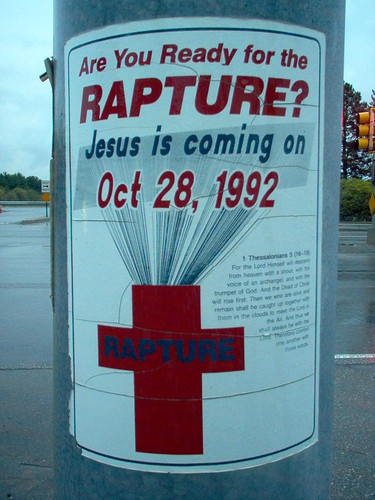
Marc Nozell via Compfight
Kurt Willems posted this excellent guide for reading the Book of Revelation as it was intended to be read. As Kurt points out, this is the most misunderstood and misinterpreted book of the Bible. If you were weaned on A Thief in the Night or the Left Behind series of books, this will be refreshing information for you.
From Kurt’s blog:
Revelation is a book that continues to be used as “trump card” against Christian nonviolence as it posits a future tribulation and war in which Christ comes back to lead people into a battle, one that apparently contradicts everything he taught during his earthly ministry. And of course there’s the baggage of the “Left Behind” series that imagines a rapture followed by the rise of an “anti-Christ” and a literal 7-year tribulation which fuels a mentality that the book is mostly about what will happen and how to escape that fate. I want to suggest that most of what you have been taught about Revelation, especially if you watched the cheesy Christian movies or grew up in conservative/fundamentalist expressions of evangelicalism, is wrong.
Category: General
Tags: Book of Revelation, Kurt Willems, Left Behind, Non-Violence, Rapture, Revelation
Related Reading
Unpacking Revelation: Is it Literal?
According to many scholars as well as many Christian laypeople, the Jesus we find in the book of Revelation engages in a great deal of violence. This violence reaches a zenith in chapter 19 where we find Jesus going out to make war on a white horse (v. 11). He is dressed in a blood…

Rethinking the Resurrection
As much as every other aspect of Jesus life and ministry, I submit that the resurrection must be understood in light of the cross. This event was not anything like the resuscitation of a random corpse. It was the resurrection of the Incarnate Son of God who had fulfilled the human side of the God-human…

Anabaptist Response to the Attacks in Paris and Beirut
https://youtube.com/watch?v=paUtIl-oRpM&feature=youtu.be Our friend Bruxy Cavey, the pastor at The Meeting House in Toronto shares some thoughts on how to respond to the violence that is going on in the world. He writes: The Meeting House is a Historic Peace Church. In responding to terrorism, we don’t presume to tell governments what they should do, for…

God’s Non-Violent Ideal in the OT
While God condescended to working within the violent-prone, fallen framework of his people in the Old Testament—as I argue in Crucifixion of the Warrior God—the OT is also full of references to how God worked to preserve his non-violent ideal as much as possible. He did this by continually reminding his people not to place…

Why Didn’t Jesus Denounce Military Service?
A common objection to the claim that Jesus and the authors of the New Testament were opposed to all forms of violence is that neither Jesus nor anyone else speaks out against it. When soldiers asked John the Baptist what they should do in response to his message, for example, he told them not to…

Getting Behind the “Letter” of Violent Portraits of God
“I will do to you what I have never done before… in your midst parents will eat their children, and children will eat their parents…” Ezek. 5:9-10 In my previous post I offered a brief review of Matthew Bates’ fascinating work, The Hermeneutics of the Apostolic Proclamation by Matthew Bates (Baylor University Press, 2012). Among other…