
We run our website the way we wished the whole internet worked: we provide high quality original content with no ads. We are funded solely by your direct support. Please consider supporting this project.

Becoming Like the Accuser
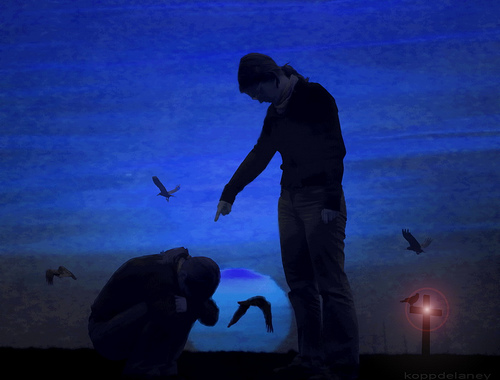
Image by h.koppdelaney via Flickr
When the Adam and Eve yielded to Satan and surrendered their God-given authority over the earth and animal kingdom (Gen 3), Satan became “the god of this world” (2 Cor. 4:4), the “ruler of the world” (Jn. 12:32; 14:31) and the “principality and power of the air” (Eph. 2:2) who “has power over the whole world” (1 Jn. 5:19).
Satan is first and foremost a judger. Throughout the Bible we find him bringing judgments against God and humans (The book of Job makes this most clear.) For good reason the Bible labels him “the Accuser” (Rev. 12:10). Not surprisingly, when Adam and Eve opened up their lives to this, they first accepted Satan’s accusation that God is a petty deity who is threatened by their access to the forbidden tree. Once they act on this false picture of God by violating the prohibition, they then judge God to be unmerciful as they hide from him in fear (Gen. 3:8).
When questioned by God, Adam blamed God as well as Eve for his misdeed. “The woman you put here with me – she gave me some fruit from the tree, and I ate it” (Gen. 3:12, emphasis added). Eve in turn also refused to own up to her sin and instead placed all the blame on the serpent (Gen. 3:12).
Though the couple was created to bear God’s image, the Accuser succeeded in getting them to take on something of his image, reflecting his ugly, accusatory character. The couple and all their descendants had become a rebel race of accusers, co-opted into the rebellion of the Powers against the Creator.
Instead of receiving and reflecting God’s life and love toward on another, we now tend to view others through the eyes of our hungry soul and our assumed “knowledge of good and evil.” In our rebellious condition, we tend to “love” those who contribute in some way to our idolatrous sense of fullness of Life—the “good” people—and we tend to despise those we judge to be detracting from our idolatrous sense of fullness of Life—the “bad” people. We judge some as worth loving and others worth hating when we’re under the influence of the Accuser and our stolen “knowledge of good and evil.”
As a result, the human community has become fragmented and filled with violence. The history of humanity has largely been a history of horrific brutality.
Our inability to refrain from violence, despite our remarkable intelligence in some areas and despite our best intentions to avoid it, is arguably the single greatest sign of our subjection to the one whom Jesus says “was a murderer from the beginning” (Jn. 8:44). When people are subjected to the Accuser and filled with judgments, violence is never far away.
The biblical record bears witness to our violent tendencies as a race of accusers. No sooner had the first couple been expelled from the Garden than their first child murdered their second, judging that Abel was in competition with him for God’s approval (Gen 4). As violence always does, this first act of violence set off a chain reaction of violence, to the point that Lamech, a descendent of Cain, boasted that his thirst for vengeance was ten times great than what God had threatened (vs. 24)!
Violence under the reign of the Accuser continued to escalate to the point that, within a couple millennia the world had become so “full of violence” the Lord had to stoop still further and start the whole creation project over again by sending a flood (Gen 6). Had he not done this, all indications are that God’s plan for the human race would have been hopelessly derailed. It was God’s only hope of rescuing the human race from irreversible destruction.
Yet, as drastic as it was, this measure did not put an end to the reign of the destructive Powers. Nor did it reform our fallen accusatory nature. Consequently, sin and violence began to encroach back into the world soon after the flood. Indeed, the rest of the biblical narrative and the whole of human history is one, long, tragic testimony to the truth that, so long as we’re separated from God, we can’t help but separate ourselves from one another. Until we are free from our bondage to the Accuser, we simply can’t stop accusing, which invariably results in some people judging that their enemies don’t deserve to live.
Category: General
Tags: Judgment, Tree of the Knowledge of Good and Evil, Violence
Topics: Following Jesus
Related Reading
What Went Wrong in the Garden of Eden?
When Adam and Eve ate from the tree, they imposed their will into the center of Paradise, and this was the act that destroyed Paradise. They invaded the proper domain of God. Instead of recognizing that they were supposed to derive life from the center, they placed themselves in the center. They tried to become…

Repent! … From the Sin of Religion
People often think that being Christian is about “being religious,” but loving others in the way that Christ instructs us is about as far removed from religion as anything could be. Religion, as I use the term, is a system of beliefs and behaviors one embraces as a means of getting life—whether this be feeling…

The Call to Suffer
Paul tells us that in all our relations, we are to “have the same attitude of mind Christ Jesus had” (Phil 2:5). Though he was “in very nature God,” he didn’t cling to this status. Rather, for our sake he set aside his divine prerogatives, took on the nature of a servant and “humbled himself…
What’s so Wrong About Knowledge of Good and Evil? (podcast)
Greg goes deep, Dan pushes back. Hold on to your notebooks! Episode 514 http://traffic.libsyn.com/askgregboyd/Episode_0514.mp3

If Judgment is the Opposite of Love, How Can God Judge? (podcast)
Greg considers how God’s judgment differs from our own, making it an expression of his love. Whereas, for us, judgment stands contrary to our love. Episode 488 http://traffic.libsyn.com/askgregboyd/Episode_0488.mp3
Cruciform Aikido Pt 1: Jesus and the Violent God
Note: Today, we are beginning a 4-part series on the subject of divine judgement called “Cruciform Aikido.” We will be publishing this once a week alongside Greg’s introduction to ReKnew series. When most people think of God judging sinners, they imagine an angry God who acts violently as he vents his wrath and brings vengeance on people.…