
We run our website the way we wished the whole internet worked: we provide high quality original content with no ads. We are funded solely by your direct support. Please consider supporting this project.

What To Do with the Bible’s Talk of Satan


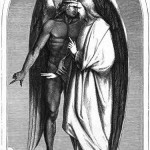
Recently, Roger Olson raised the question on his blog about why Satan is ignored in modern theology. He observed how Greg’s theology takes an “obvious, ‘up front,’ blatant belief in a very personal, very real, very active Satan who has great power in the world.” Because we often have so little to say about Satan and the problem of evil, we are left with imaginary caricatures passed on to us from our culture like the silly one depicted in the image above. What follows are some key passages from Greg’s landmark book on this topic, God at War, that can point us in the right direction:
“[B]iblical authors generally assume the existence of intermediary spiritual or cosmic beings. These beings, variously termed ‘gods,’ ‘angels,’ principalities and powers,’ ‘demons,’ or, in the earliest strata, ‘Leviathan’ or some other cosmic monster, can and do wage war against God, wreak havoc on his creation and bring all manner of ills upon humanity. Whether portraying Yahweh as warring against Rahab or other cosmic monsters of chaos or depicting Jesus as casting out a legion of demons from the possessed Gerasene, the Bible as well as the early postapostolic church assumes that the creation is caught up in the crossfire of an age-old cosmic battle between good and evil. …
If we modern Westerners cannot “see” what nearly everyone else outside the little oasis of Western rationalism the last several centuries has seen, then perhaps there is something amiss with our way of seeing. It is just possible that the intensely materialistic and rationalistic orientation of the Enlightenment has blinded us to certain otherwise obvious realities. It is just possible that our chronocentrism—our tendency to assume that the worldview we hold at the present time is the ultimately true worldview—is preventing us from seeing significant feature of reality” (18).
“The central difference in perspective between the New Testament and early postapostolic church on the one hand and Augustine and the later church on the other is that the former almost unanimously locates the ultimate reason for why there is evil in the world is the evil will of Satan, while the post-Augustine church and the whole of the classical-philosophical tradition following him tends paradoxically to locate the ultimate rationale for evil within the mysterious, omnibenevolent, all-encompassing will of the Creator. …
The later church thereby acquired an intellectual problem with evil that the New Testament simply does not have. For a variety of reasons, the later church attempted to understand evil as a function of God’s all good and all controlling providence rather than as a function of Satan’s evil, controlling rule of the world. The former is problematic while the latter is not, assuming (as the New Testament does) that angelic free will is intelligible. If a self-determining, supremely evil being rules the world, then it is hardly surprising that it is deluged with nightmarish evil, despite having been created by an all-good, omnipotent Creator. …
[I]t is quite peculiar that after Augustine, through the church’s history up to the present, very few thinkers conceived of Satan as being in any way relevant to, let alone central to, the solution to the problem of evil. It is remarkable that the one who in Scripture and in the earliest postapostolic fathers is depicted as the ultimate originator of evil and the one ultimately behind all the world’s horrors has been thoroughly ignored in discussions on the problem of evil” (54-55).
Category: Q&A
Tags: Free Will, Problem of Evil, Spiritual Warfare, Warfare Worldview
Topics: Spiritual Warfare, Cosmic Conflict, The Problem of Evil
Related Reading

Vacationing in a War Zone
Suppose a family decided to go on vacation to a nice cabin on a beautiful shore in a distant country. This vacationing family naturally wanted to tune out the problems of the world, indulge themselves, relax and enjoy life and each other as much as possible. This is simply what families do on vacation. Now…
What Does Spiritual Warfare Have To Do with the Cross?
Last week, we covered a few posts on the nature of the Atonement and the Christus Victor view. The following continues this theme, specifically looking the motif of spiritual warfare and how it relates to Christ’s work on the cross. This is an adaptation from Greg’s article in The Nature of the Atonement: Four Views. …

Let Us Pray
Per Ola Wiberg via Compfight It’s appropriate to pray and reflect and run to God when tragedies like the one in Newtown, CT take place. We wanted to share a couple of things we found helpful around the blogosphere as we struggle through our sadness. T.C. Moore shared some thoughts on Darkness, Advent, and Newtown CT on…

Three Arguments Against Determinism
There was an interesting article in the NY Times yesterday by John Tierney entitled “Do You Have Free Will? Yes, It’s The Only Choice.” The article reviews research that suggests that everybody intuitively believes people are morally responsible only for actions they could have refrained from doing and that when people don’t believe they are free…

Free Will: What is a free agent?
What does it really mean to be a free agent? In this reflection, Greg offers some thoughts on free agents and how it can be that they are not exhaustively determined.

Storming the Gates of Hell
Jesus said: “I will build my church, and the gates of Hades will not prevail against it.” (Mt 16:18) To understand Jesus’ teaching here, there are a few things you should know. First, “Hades” was the standard term for the underworld, which means that Jesus was probably referring to the whole of the Satanic kingdom.…