
We run our website the way we wished the whole internet worked: we provide high quality original content with no ads. We are funded solely by your direct support. Please consider supporting this project.

Benefit of the Doubt: Sneak Peek
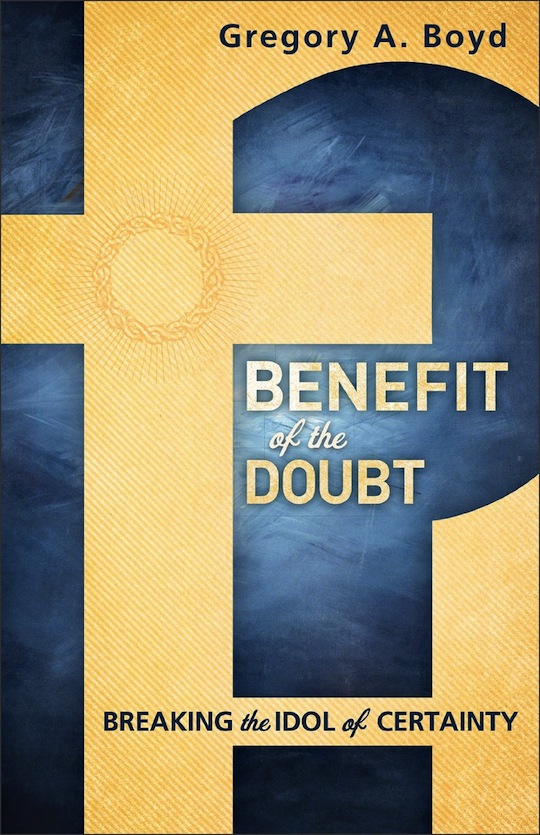 We’ll be leaking little tidbits from Greg’s soon-to-be-released book Benefit of the Doubt from today until the book release. We’re really excited about the potential of this book to impact the lives of those who have limped along with the assumption that doubts and questions disqualify them as “faithful”. Here’s today’s snippet:
The truth is, the process of learning and growing almost always involves a certain amount of pain. Perhaps you, like me, were a child who found it very hard to accept that Santa Claus wasn’t real. I fought my doubt for at least a year, and when my older brother finally convinced me, I cried. Then I got angry—very angry. Feeling I’d been duped, I vowed I’d never believe anything anyone ever told me again. While this pledge thankfully didn’t stick, I sometimes wonder if this experience is part of the reason I have always had a skeptical streak. I don’t like being fooled.
This experience illustrates how painful growing out of old, cherished beliefs can be, which is why we sometimes fight tenaciously, and often irrationally, to resist letting them go, or even letting go of our certainty about them. And yet, if we want to continue to grow, and if we are genuinely concerned with believing the truth, there is no way to avoid this pain. Indeed, having the courage to embrace the pain of doubt and to face unpleasant facts, as well as to embrace challenging questions and to live with ambiguity, is the hallmark of a mature and responsible human being. As we’ll see in the next chapter, one of the unfortunate consequences of the certainty-seeking model of faith is that it encourages pain-avoidance and thus keeps people from learning, growing, and maturing.
Boyd, Gregory, Benefit of the Doubt: Breaking the Idol of Certainty, Baker, 2013
Also, today and tomorrow are the last days to get the early bird registration rate for ReKnew’s upcoming conference Faith, Doubt & the Idol of Certainty. Hope to see you all there!
Category: General
Tags: Benefit of the Doubt, Doubt, Doubt and the Idol of Certainty, Faith, ReKnew
Related Reading

What Type of Faith Do You Have?
Genesis 32 tells the story of Jacob, wrestling through the night with a nameless man, revealed to be none other than God Himself. We read that when this man “saw that he could not overpower” Jacob, he “touched the socket of Jacob’s hip so that his hip was wrenched as he wrestled with the man”…

When Free Will Meets Unfathomable Evil
In the face of tragedy Christians unfortunately tend to recite clichés that attempt to reassure people that, however terrible things seem, everything is unfolding according to God’s mysterious plan. We hear that “God has his reasons”; “God’s ways are not our ways”; “God is still on his throne”; “God doesn’t make mistakes,” and things of…
What Causes You Doubt?
In this first episode of the Apologies and Explanations Podcast, Greg shares some of his own experiences with doubt and talks about how doubt has ultimately made his faith stronger. Links: Greg’s book: “Benefit of the Doubt” Website: ReKnew.org http://traffic.libsyn.com/askgregboyd/Episode_0001.mp3
Quotes to Chew On: Doubt
Gisela Giardino via Compfight Marcus Goodyear wrote an article back in 2011 reflecting on Mother Teresa’s experience of doubt. Many now know that although Mother Teresa worked tirelessly in the slums of Calcutta, she struggled with doubt and spiritual isolation most of her life. Marcus finds this comforting in some way, and he relates to…
The Lord of Legend and Love
However secularized a person may be, if they have any sense at all that life has a meaning, they know it must have something to do with love. Indeed, one could argue that all of our intuitions about morality and the meaning of life are at root an intuition about the supremacy of love. At…
Rethinking Our View of Faith
The second conviction of the “ReKnew Manifesto” is that we need to rethink what it means to have faith. It’s my impression that many, if not most, Evangelical Christians associate their assurance that they’re “saved” with their confidence that they believe correct doctrines. This is why many, if not most, think that heretics who believe…